What should you check before buying a container house from China? Chinese container homes are booming, yet cross-border purchases carry real risks. Skipping any of these 10 checks can cause costly mistakes, delays, or safety issues. This container house buying guide gives you clear, actionable steps anyone can follow, even without technical expertise. A trusted China prefab supplier like Wanbang Modular Building can help you avoid common mistakes when buying container houses from China. Whether you purchase a container home for a remote camp or buy a container house for personal use, proper due diligence matters. Use this container house supplier checklist to protect your investment. This complete container house guide covers every detail for purchasing a container home safely.
Key Takeaways
-
Check the metal frame and ask for inspection reports to ensure safety and quality.
-
Confirm the size and layout match your site and lock the final design in writing.
-
Review materials, insulation, electrical, and plumbing to fit your climate and needs.
-
Verify local permits and calculate all costs, including shipping and installation.
-
Vet the manufacturer, approve final drawings, and get written sign-off before production.
Verify Structural Integrity
Check Frame Thickness and Shape
The metal frame is the backbone of any container house from China. It carries the entire load of the structure, so weak steel means serious safety risks. Ask your supplier for exact frame specifications before you commit. A quality China prefab supplier will share these details without hesitation.
Look for high-strength galvanized steel. This material resists rust and provides structural stability for multi-year use. The table below shows typical frame component specifications you should expect.
|
Frame Component |
Material / Type |
Dimension (mm) |
Thickness (mm) |
|---|---|---|---|
|
Top frame square tube |
Q235B Rectangle square tube |
37×37 |
1.1 |
|
Top frame square tube |
Q235B Rectangle square tube |
60×60 |
1.5 |
|
Bottom beam |
— |
60×80 |
1.5 |
|
Corner piece plate |
— |
140×180 |
3.0 |
|
Hanging head board |
— |
140×155 |
3.0 |
A sloped roof, overhang, and gutters also signal quality design. These features direct water away from the structure and reduce long-term damage. Wanbang Modular Building uses galvanized steel frames with bolted structural systems. This approach simplifies assembly and strengthens the overall build.
Demand Inspection Reports
Never skip quality inspection documents when buying a container house from China. These reports prove the frame meets load-bearing requirements. Ask for a welding inspection report covering penetration, porosity, and alignment on load-bearing joints. Welding defects are the highest-frequency issue affecting structural integrity.
Request a pre-shipment inspection report from SGS, BV, TUV, Intertek, or CCIC. These reports check dimensions, materials, welding, electrical systems, and packaging against specifications. A dimensional check report ensures frame squareness within 3mm. Material verification confirms steel grade Q235B or Q345B.
Inspectors in 2025 are increasingly asking for welding inspection reports (CWI) for all structural modifications to shipping containers, as structural modification is the primary failure point for residential code compliance under IBC Section 3115.
Use this container house supplier checklist when sourcing container houses from China. A reliable container house supplier will provide these documents on request. This step protects your container home for years to come.
Confirm Dimensions and Layout
Match Measurements to Your Site
Final layout confirmation is one of the most commonly missed details when you buy a container house China. Many buyers focus on price and forget to measure their actual site. Before you pay a deposit, compare the unit's footprint against your available land, access road, and crane reach.
You must also compare internal versus external dimensions. The steel walls and floor consume space, so the room you stand in is smaller than the box you ship. The table below shows the standard difference for a 20-foot unit.
|
Measurement |
Internal |
External |
Difference |
|---|---|---|---|
|
Height |
2.39 m (7 ft 10 in) |
2.59 m (8 ft 6 in) |
0.20 m (8 in) |
|
Width |
2.35 m (7 ft 9 in) |
2.44 m (8 ft) |
0.09 m (3 in) |
|
Length |
5.89 m (19 ft 4 in) |
6.10 m (20 ft) |
0.21 m (8 in) |
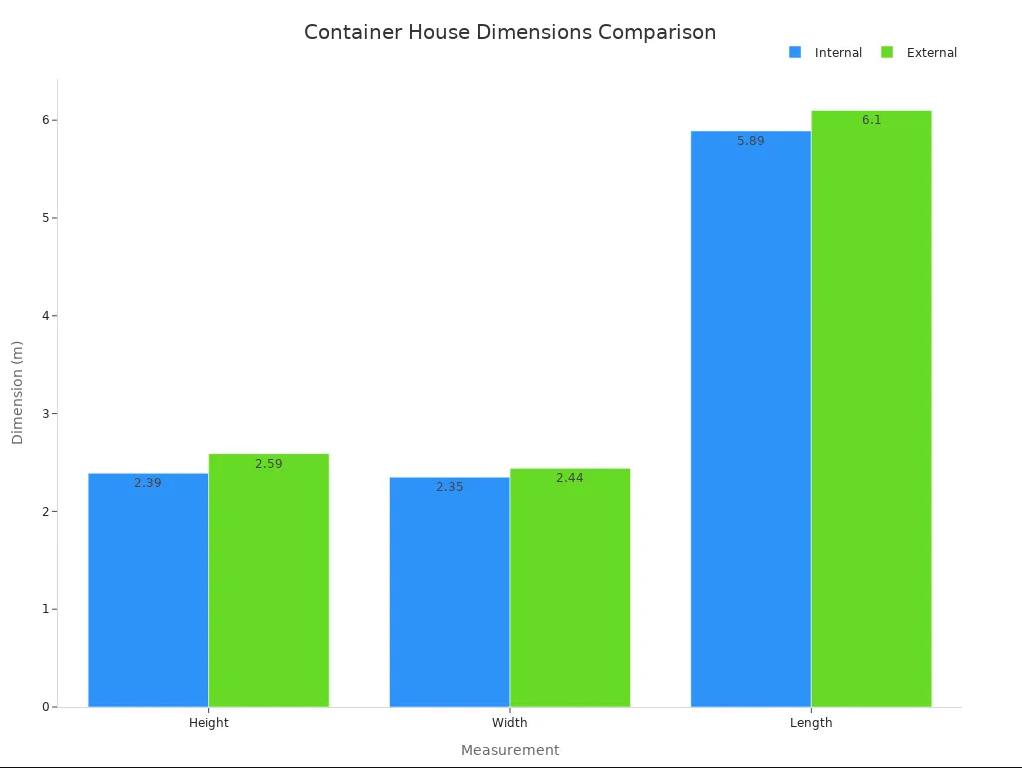
Plan your furniture, beds, and equipment around the internal figures. A container home that looks spacious on a drawing can feel cramped once you subtract wall thickness.
Lock the Final Room Layout
Bathroom and kitchen details are often overlooked. You need to confirm the position of the toilet, shower, sink, and drain before production starts. Ask your China prefab supplier for a full layout drawing with every fixture marked.
Lock the final room layout in writing. Changing a wall or a door after production begins costs money and delays your delivery. A container house supplier checklist should always include a signed layout approval step. Wanbang Modular Building reviews your project drawings and confirms suitable building configurations before the factory cuts any steel.
Walk through the layout as if you were living in it. Check door swing directions, window heights, and the path from the kitchen to the bathroom. Small adjustments at this stage are free. Small adjustments later are not.
Inspect Materials and Build Quality
Review Wall and Roof Panels
Ask your supplier for material spec sheets before you buy a container house China. These documents tell you exactly what goes into the walls and roof. A trustworthy China prefab supplier will share them without pressure.
Rock wool sandwich panels are a common choice for container houses from china. They offer fire resistance and thermal insulation. The table below shows typical specifications you should confirm.
|
Specification |
Value |
|---|---|
|
Steel thickness |
0.4, 0.5, 0.6, 0.7, 0.8 mm |
|
Rock wool core density |
100 / 120 kg/m³ |
|
Thermal conductivity (λD) |
0.043 W/mK |
|
Acoustic insulation |
27 dB |
|
Effective width |
1000 mm (options: 950, 1150 mm) |
|
Fire resistance |
EI 90 / E 120 / EW 60 |
A1-grade non-combustible rock wool is available as a material-level specification. This rating means the core will not fuel a fire. Low-quality panels may contain harmful chemicals like formaldehyde-based binders. These chemicals can off-gas into your living space. Always ask for the fire test standard and whether the test covered the core material or the complete panel.

Check Welding and Finish
Welding quality determines how long your container home lasts. Poor welds crack under load or let water into the frame. Request a quality inspection report that covers penetration, porosity, and alignment on all load-bearing joints. A container house supplier checklist should always include this document.
Inspect the finish on every panel edge and frame corner. Sharp burrs, uneven paint, and exposed steel signal rushed production. Wanbang Modular Building uses galvanized steel frames with bolted structural systems. This design reduces reliance on field welding and speeds up assembly. Ask your supplier for close-up photos of welded joints and finished surfaces before shipment.
Check Insulation and Climate Fit
Confirm R-Values and Thermal Ratings
Is the container properly insulated for your climate? This question determines whether your container house stays comfortable year-round or becomes unbearable in extreme heat or cold. Start by asking your China prefab supplier for the R-value of every wall, roof, and floor panel. A higher R-value means better thermal resistance.
Spray foam insulation offers one of the best solutions for container homes. It has a high R-value and acts as a vapor barrier. The foam sprays onto interior and exterior walls, expands, and hardens. This process improves thermal resistance and helps prevent condensation. Floor insulation also improves comfort and energy efficiency while providing a barrier against moisture and pests.
Consider the climate where you will place your unit. In milder climates, exterior insulation may be less necessary. In areas with extreme temperatures, exterior insulation helps keep the container comfortable year-round. Wanbang Modular Building supplied 150 modular housing units for a power transmission camp in Chile's Atacama Desert. That project proves their buildings handle one of the harshest environments on Earth.
Fenestration also affects climate performance. Doors and windows are weak points for heat transfer. Ask your container house supplier checklist to include window U-values and door seals. Double-glazed windows and tight door frames reduce energy loss and keep your interior stable.
Verify Moisture and Pest Protection
Shipping container homes are more vulnerable to condensation than traditional buildings. Metal structures are tightly sealed, non-permeable, highly thermally conductive, and have low specific heat capacity. These properties trap moist air indoors and allow condensation to form on cold surfaces or thermal bridges. You need proactive moisture-control measures to prevent problems.
Prevent indoor moisture sources first. Keep high-moisture activities such as cooking, bathing, and laundry outside conditioned areas. Use insulation and install vapor barriers to block moisture movement. Fix leaks, keep drains and gutters clear, and insulate pipes prone to condensation because condensation can provide water for pests.
Pest protection requires attention to small openings. Repair broken windows, screens, vent covers, and holes in exterior walls quickly because rodents can enter through very small openings. Fix doors and windows that do not close completely. Seal gaps at the bottom of doors with weatherproof sweeps or thresholds so the gap is less than 1/4 inch. Place screens over HVAC air intake and exhaust vents, and cover fan and vent openings with galvanized mesh with openings of 1/4 inch or smaller. Seal openings around piping, duct work, wires, conduits, plumbing, and sewer lines using caulk, sheet metal, knitted copper mesh, steel wool, spray foam insulation, or cement.
Review Electrical and Plumbing
Verify Voltage and Outlet Standards
Electrical systems vary by country, and a mismatch can damage your appliances or create a fire hazard. Before you buy a container house China, confirm the voltage, frequency, and outlet type your supplier will install. A China prefab supplier builds to the destination market, so you must state your country's standard clearly in the purchase order.
Ask for a wiring diagram that shows circuit breakers, grounding, and outlet placement. Check that the panel accepts your local plug shape without adapters. If you plan to run heavy equipment, confirm the amperage rating of each circuit. Wanbang Modular Building provides transparent specifications and project documentation on request, including electrical layouts that match your region.
Confirm Pipe Materials and Layout
Plumbing must be planned before purchase, not after. Once the factory seals the walls, moving a drain line becomes expensive and disruptive. Decide the location of every sink, toilet, and shower during the drawing approval stage. A container house supplier checklist should always include a signed plumbing layout.
PVC pipes are a common choice for shipping container plumbing because they are durable and cost-effective. Proper measurement and cutting prevent leaks or blockages. The table below compares your main options.
|
Pipe Material |
Notes |
|---|---|
|
Copper |
Traditional, widely available, relatively affordable, but installation is more involved in compact container spaces and may need extra insulation against freezing. |
|
PVC |
Traditional, widely available, relatively affordable, but installation can be more involved in tight container spaces and may require additional insulation in cold weather. |
|
PEX (cross-linked polyethylene) |
Alternative system offering greater flexibility and easier installation, especially in tight spaces, but material costs may be higher. |
|
Push-fit plumbing |
Alternative system offering greater flexibility and easier installation in tight spaces, but material costs may be higher. |
Choose the material that fits your climate and budget. Then lock the layout in writing before production begins. This step protects your container home from costly rework later.
Confirm Local Codes and Permits
Check Zoning and Foundation Rules
What are my local council regulations? You must answer this question before you place any order. Zoning rules vary widely by region, and they determine whether you can legally place a container house on your land. Start by contacting your local planning department and asking about council approval requirements for prefabricated structures.
Common restrictions include minimum square footage, front and side setbacks, and lot coverage ratios. Some zones allow container homes easily, while others require lengthy variance processes. Agricultural zones often have the lowest barriers. Historic districts and planned unit developments impose strict aesthetic rules that a metal box cannot satisfy. Homeowners associations can veto your project entirely.
The International Building Code Section 3115.1 explicitly validates containers as safe building materials for homes. If a zoning board claims containers are unsafe, this code section refutes that claim. When you need a variance, submit a site plan, provide written justification, notify neighbors, attend a public hearing, and wait for the board's decision. This process typically takes 60 to 90 days.
Verify Import and Safety Compliance
Before sourcing container houses from China, confirm the certifications your supplier holds. ISO 9001, ISO 14001, and ISO 45001 management system certifications signal a factory that follows documented quality and safety processes. EU CE marking applies to relevant products and supports project review. These documents help, but local approval still depends on your destination country's building codes and engineering review.
You also need import documents for customs clearance. A commercial invoice and packing list are standard requirements. Ask your China prefab supplier for these records early. Wanbang Modular Building provides transparent specifications and comprehensive project documentation on request.
Consider local options first before importing. A domestic supplier may simplify compliance and reduce shipping complexity. If you proceed with buying a container house from China, verify every certificate and keep copies for your records. A thorough container house supplier checklist protects your investment and ensures your container home meets all legal requirements.
Calculate Total Landed Cost
Add Shipping, Customs, and Duties
The factory price is only the starting point. A typical unit costs around $15,800 for the house itself, plus door-to-door shipping. That shipping quote covers ocean freight, port handling, and final delivery, but it rarely includes customs duties or taxes. Ask your China prefab supplier for a written breakdown of every charge between the factory gate and your site.
Set a landed budget, not a factory budget. The true landed cost includes the unit, freight, insurance, customs clearance, duties, and inland transport. Buyers who compare only factory pricing often face surprises at the port. A container house cost guide should always separate these line items so you can see the real total cost before you commit.
Budget for Installation and Site Work
Site preparation, foundations, utilities, and installation usually sit outside supplier scope. Wanbang Modular Building supplies the units and project documentation, but your local team handles the ground work. Budget for these hidden container house costs early.
|
Foundation Type |
Best For |
Cost (USD) |
Preparation Time |
|---|---|---|---|
|
Concrete Pad |
Permanent |
$500–$2,000 |
3–7 days |
|
Ground Screws |
Temporary |
$200–$500 |
1–2 days |
|
Gravel Base |
Semi-permanent |
$100–$300 |
1–2 days |
|
Steel Frame |
Elevated |
$300–$800 |
2–3 days |
Beyond the foundation, plan for these items:
-
Installation: $200–$500 per unit
-
Utilities: $300–$1,000 per unit
-
Permits: $200–$1,000
A new electrical service can average $12,250 for a 500-foot run. Connecting to an existing sewer runs $1,000–$15,000. Site clearing and grading averages $1,000–$5,000. When you buy and ship a container house, these figures decide whether your project stays on budget. Use a container house supplier checklist to confirm what your supplier covers, then price the rest locally. This step turns a vague container house installation cost into a real number.
Review Quotation and Payment Terms
Break Down What Is Included
A low price often hides missing certifications or hidden fees. When you buy container house China, the cheapest quote rarely delivers the best value. Ask every supplier for a line-by-line breakdown of the quotation before you compare pricing across vendors.
A complete quotation covers far more than the unit itself. The table below shows what a transparent Chinese supplier should itemize.
|
Category |
Items typically included |
|---|---|
|
Product & size |
Product type; 10ft / 20ft / 30ft / 40ft size; quantity |
|
Layout & structure |
Layout and room function; door and window positions; final layout confirmation |
|
Materials & insulation |
Wall panel specification; insulation requirement |
|
Bathroom & kitchen |
Bathroom, toilet, shower, or kitchen configuration; bathroom and kitchen details |
|
Electrical & plumbing |
Electrical requirement/standard; plug type; plumbing requirement; drainage plan |
|
Trade & shipping |
Destination port; EXW or FOB trade term; packing method/dimensions; loading quantity |
|
Documentation & support |
Installation guidance; drawings and specifications; loading photos before shipment; accessory list; spare parts |
|
Local conditions |
Local unloading and installation plan; local unloading conditions |
Confirm the EXW or FOB quotation basis in writing. This term decides who pays for inland transport, port charges, and loading. A vague trade term creates disputes later.
Check Payment Schedule and Penalties
Your payment schedule should tie to project milestones, not calendar dates. Never pay more than 10–15% upfront before any work starts. Tie the remaining balance to foundation, framing, rough-in, and finishing stages. This structure protects your container house order from delays and abandoned production.
Your contract must also cover change orders, timeline penalties, and warranty terms. Require written change orders with agreed pricing before work proceeds. Verbal approvals create confusion. The contract should specify milestone dates and state what happens if the supplier misses them. Include warranty terms of at least one year for workmanship, lien waiver provisions, and a dispute resolution clause that requires mediation before litigation.
Watch for late fees, damage penalties, and early termination clauses. These terms affect your total pricing more than the unit price alone. A thorough review of your container home quotation now prevents costly surprises after shipment.
Vet the Manufacturer
Check Business License and History
Marketplace listings on Alibaba, eBay, or Amazon can hide weak suppliers. Anyone can post a product photo. You need proof that the factory exists and operates legally. Start your supplier evaluation checklist with the business license. Ask the manufacturer for its legal registration documents. Request the factory address to confirm the company's physical location. A legitimate China prefab supplier will share these details without delay.
Review the company's export records and production history. A factory with years of experience shipping container houses from china will have a clear track record. Confirm the company holds relevant certifications such as ISO 9001, CE, and SGS. Verify certification paperwork directly with the issuing organization. For larger orders, arrange a third-party factory audit and pre-shipment inspection. These steps protect your container house order from fraud.
Request References and Factory Video
Reading reviews and researching others' experiences will reveal a supplier's true reputation. Ask for case studies and references from previous customers, especially in your target market. Arrange a live video tour of the production facility. Watch how workers handle steel, panels, and wiring. Review production records and recent project references before you commit.
Wanbang Modular Building offers documented deliveries in Suriname and Australia. In Suriname, they delivered 200 container houses and 12 toilet houses for a road construction project camp. In Australia, they provided 40FT expandable container houses offering 56 sqm of living space. These references show real project experience. When buying a container house from china, ask every potential supplier for similar proof. A container home purchase deserves the same diligence you apply to any major investment. Request a factory video, check the business license, and confirm every reference before buying container houses from china.
Approve Final Drawings
Review Every Dimension and Material
Final layout confirmation must happen before production begins. Once the factory cuts steel and welds frames, changes become expensive and slow. You should treat drawing approval as the last gate before your container house order moves to the production line.
Ask your China prefab supplier for three documents: layout drawings, a material list, and an installation manual. The layout drawing shows every wall, door, window, and fixture position. The material list confirms panel types, insulation, and finishes. The installation manual guides your local team through assembly. Wanbang Modular Building provides all three on request, along with inspection reports and loading photos.
Review every dimension against your site plan. Check door swing directions, window heights, and the path between rooms. Verify that the material list matches the specification sheet you approved earlier. A quality inspection at this stage catches errors before they become permanent. Compare the drawing to your container house supplier checklist and mark any missing item.
Get Written Sign-Off on Changes
Verbal approvals create confusion. You need written sign-off on every change before production starts. When you buy container house China, the supplier builds to the approved drawing. Any verbal promise about a moved wall or added outlet will not appear in the final unit.
Create a simple change log. Record each revision, the date, and both parties' confirmation. Ask your supplier to sign and return the updated drawing. This step protects your container home from costly rework and disputes.
Sourcing container houses from china works best with documented sign-off. You gain a clear record of what you ordered. The supplier gains a clear target for production. Wanbang Modular Building reviews your project drawings and confirms suitable configurations before cutting any steel. Request quotes, compare suppliers, and never skip final drawing approval. This habit protects your money, your timeline, and your safety.
These 10 checks protect your money, timeline, and safety. A low price often hides missing certifications, weak materials, or hidden fees. Treat this final buyer checklist as your shield against costly surprises.
Use it before you buy a container house. Request every document from your China prefab supplier. Then request quotes, compare suppliers, and never skip final drawing approval. Wanbang Modular Building welcomes your project drawings and provides full documentation for every container house order. A careful container home purchase starts with verified facts, not hopeful guesses.
FAQ
What documents should I request from a China prefab supplier before paying a deposit?
Ask for the business license, ISO 9001, ISO 14001, and ISO 45001 certificates, plus EU CE marking where it applies. Request a welding inspection report, a pre-shipment inspection report from SGS, BV, TUV, Intertek, or CCIC, and a dimensional check report. Wanbang Modular Building provides these on request.
How do I avoid hidden fees when I buy container house China?
Set a landed budget instead of a factory budget. Ask for a line-by-line quotation covering the unit, ocean freight, insurance, customs clearance, duties, and inland transport. Site prep, foundations, utilities, and installation usually sit outside supplier scope, so price those locally before you commit.
Which certifications prove a container house supplier checklist is complete?
A complete checklist covers management system certificates, product-level fire ratings such as A1-grade non-combustible rock wool, and third-party inspection reports. Confirm steel grade Q235B or Q345B and frame squareness within 3mm. Verify each certificate directly with the issuing organization rather than trusting a scanned copy.
Can Wanbang Modular Building handle extreme climates?
Yes. Wanbang supplied 150 modular housing units for a power transmission camp in Chile's Atacama Desert, one of the harshest environments on Earth. The company also delivered 200 container houses and 12 toilet houses in Suriname, plus 40FT expandable container houses offering 56 sqm in Australia.
What is the biggest mistake buyers make before production starts?
Skipping final drawing approval. Once the factory cuts steel, moving a wall or a drain line becomes expensive and slow. Review layout drawings, material lists, and installation manuals, then get written sign-off on every change. This single habit protects your money, timeline, and safety.