Modular workforce accommodation is a prefabricated housing solution that delivers dormitories, dining halls, and support facilities to oil and gas projects as factory-built units assembled on site.
Remote sites, long shifts, extreme climates, and tight schedules make permanent housing impractical. Crews arrive for a drilling program or a completions campaign, then move on. Fixed construction cannot follow that rhythm. A relocatable camp can.
This article examines the building blocks of a modern camp, the design priorities that harsh environments demand, the construction advantages that shorten schedules, and the criteria buyers should apply when selecting a provider.
Key Takeaways
-
Modular camps arrive factory-built and ready to assemble, so crews can settle in fast.
-
These camps scale up or down easily, matching the workforce size for each project phase.
-
Factory construction cuts build time by 30–50% compared to traditional methods.
-
Modular units can be moved and reused, spreading costs across multiple projects.
-
Choose providers with full-service delivery, proven certifications, and strong references.
What Is Modular Workforce Accommodation?
Definition and Core Concept
Modular workforce accommodation is a managed housing solution that combines living quarters, dining, hygiene, and administrative space into prefabricated units assembled on site. The industry often calls these facilities man camps. In practice, a modular camp functions as remote workforce housing that supports shift routines and keeps daily life predictable.
Six functional elements define the concept:
| Attribute | Function |
|---|---|
| Controlled living environment | Separates living zones from operational support areas and supports shift-work routines |
| Integrated living and support functions | Combines accommodation, dining, hygiene, and administration to reduce congestion |
| Engineered safety and comfort | Meets fire performance, circulation, HVAC, ventilation, and acoustic requirements for long rotations |
| Modular delivery | Prefabricates units for efficient installation and commissioning |
| Sustainability | Integrates energy-efficient systems, controlled wastewater handling, and water-saving fixtures where conditions allow |
| Flexible capacity | Adjusts bed count and facility mix as staffing levels or work packages change |
Each element serves a purpose on a live project. The controlled environment keeps night-shift crews insulated from daytime activity. Integrated functions cut travel time between bed, meal, and muster point. Flexible capacity lets a camp grow with a drilling program and shrink at demobilization.
Contrast with Conventional Site Housing
Conventional site housing suits projects with a long operational horizon and stable headcount. Permanent dormitories and canteens make sense when a field will produce for decades and the ground supports conventional foundations. That approach delivers familiar construction methods and straightforward long-term maintenance.
Modular accommodation fits a different profile. It serves projects with defined campaigns, moving well pads, or seasonal programs. Factory-built units arrive commissioned and ready for connection. The modular model also allows partial relocation when scope shifts, which fixed housing cannot match.
Neither option wins universally. The right choice depends on project duration, site access, climate exposure, and how often the workforce profile will change. Buyers who map those variables against each delivery model usually reach a clear answer.
Why Oil and Gas Camps Need Modular Man Camps
Operational Demands of Remote Sites
Remote fields impose a logistics burden that few operators want to carry alone. Camp mobilization involves procurement, transport, installation, utilities, and staffing under schedule pressure. A specialist delivery partner absorbs that risk.
"Your core business is mining, energy, or construction—not camp logistics. Hand over the most complex, high-risk part of your mobilization to a team that does this, and only this, every single day."
Capacity must flex with staffing levels and project scope. A drilling program may need a small crew, while a completions or fracking campaign brings a larger workforce for a shorter window. Modular man camps scale up or down without rebuilding fixed structures. This flexibility supports wellsite drilling, completions, and fracking programs across every phase, from exploration to production.
Worker Welfare and Productivity Gains
Long shifts carry heavy physical and cognitive loads. Poor housing drives fatigue, accidents, and turnover. Quality remote workforce housing reverses that pattern. Acoustic design, reliable utilities, healthy meals, and recreation space help crews rest properly and return to work sharp.
Isolation adds mental strain. Workers separated from family and familiar surroundings need stable, comfortable living conditions. Standardized, compliant facilities improve morale and retention on oil field projects. Self-contained utilities and fire safety systems keep the site safe and self-sufficient.
The economics favor this model. Temporary housing costs less than permanent construction when the workforce is temporary or the project is short-term. Operators on drilling, refining or pipeline construction sites gain a compliant camp without a long-term capital commitment. Teams on drilling, pipeline, lng or refinery projects gain the same advantage. Modular worker camps deliver that certainty, and modular camps of this kind keep oil and gas camps productive from the first shift.
Key Components of Oil Field Man Camps
Every oil field man camp rests on five building blocks: accommodation, dining, sanitary facilities, offices, and support spaces. Each block must work with the others. A camp with excellent dormitories and weak utilities still fails the crew.
Living Quarters and Catering
Accommodation units range from single-occupancy rooms to shared dormitories. Designers balance privacy, comfort, and ventilation against budget and available space. These oilfield accommodation modules typically include:
-
Beds, storage, and electrical outlets sized to the rotation
-
Heating and cooling matched to the local climate
-
Private or shared bathrooms, depending on budget and footprint
-
Stackable layouts that shrink the site footprint
-
Insulation and full climate control for year-round use
-
A service life of 25+ years, even with frequent relocation

Catering deserves equal attention. Dining halls must serve large crews quickly across shift changes. Kitchens handle preparation, while customizable menus cover dietary restrictions. Theme nights and event menus keep morale high on long rotations. Recreation amenities such as satellite TV, high-speed internet, and fitness facilities complement the dining program. Together, these features form the core of complete accommodation, catering, offices and support facilities.
Offices, Welfare Spaces, and Utilities
Administrative offices house management, security, and healthcare services. Recreation lounges, fitness centers, and entertainment rooms give crews space to decompress. Sanitary blocks with showers and laundry maintain hygiene standards across the camp.
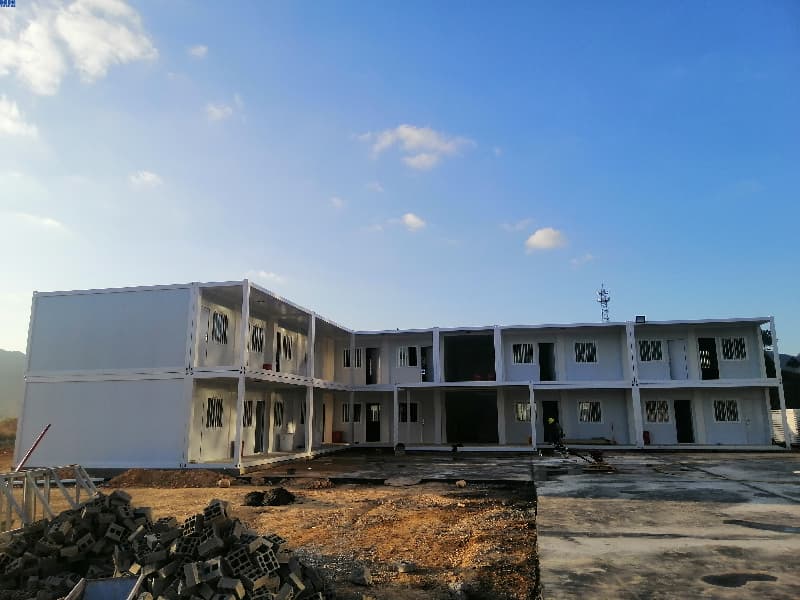
Housing formats vary by site. Skid-mounted units suit fast relocation. Wheeled units move between wellsites without cranes. Offshore modules serve marine platforms. Blast-resistant units protect crews in process areas. Modular container layouts combine dormitories and offices in one stacked structure, which simplifies logistics for oil and gas camps.
Utilities keep the camp alive. Standard systems include:
| Utility Category | Standard Systems |
|---|---|
| Power | On-site generation, portable power services, fuel supply |
| Water | Potable water systems, freshwater supply |
| Waste | Wastewater trailers |
| Support | Housekeeping services |
Portable utility services sustain the workplace and keep people feeling supported. These systems let modular man camps operate independently of local grids. That independence matters on remote sites where public infrastructure is absent or unreliable. Planners who treat utilities as an afterthought often face costly retrofits later. Early coordination between the accommodation supplier and the utility contractor prevents that outcome.
The component mix shifts with project scope. A small drilling program may need only dormitories and a dining hall. A larger campaign adds offices, recreation space, and expanded sanitary capacity. This flexibility defines oil field man camps at their best. Operators who map components against headcount and rotation length avoid both overcrowding and wasted space. The same discipline applies to oil and gas field accommodation anywhere, from desert basins to arctic fields. Buyers comparing france oil and gas field housing units with domestic options should apply identical component checks. A complete bill of components, priced and scheduled early, protects the project budget. Every oil field man camp succeeds or fails on this foundation. Well-planned oil field man camps also account for future expansion, so the camp grows with the project rather than against it.
Design Priorities for Harsh Environments
Safety and Regulatory Compliance
Safety planning starts before fabrication. Designers must address fire protection, ventilation, accessibility, and site operations as one system. Local building regulations and permits shape the layout, and energy performance rules influence insulation and glazing choices. Technical standards and service routines belong in the same review.
Compliance with Standards: Choose products that meet OSHA (Occupational Safety and Health Administration) and ANSI (American National Standards Institute) requirements. Compliance ensures your system is designed to meet strict safety guidelines and can help protect your organization from costly liability.
Winter adds complexity in northern locations. Snow, darkness, storms, and low temperatures affect transport, establishment work, and installation. The Hammerfest project shows these pressures: a remote northern site, difficult winter conditions, limited local capacity, and modules moved by boat. Planners who model these risks early protect the schedule.
Climate Control and Comfort
Standard units suit mild conditions. Cold-resistant units extend the design range to -50°C, with roof insulation at 150-190mm rock wool and wall insulation at 110-160mm composite. Triple-layer Low-e windows cut thermal transmittance to roughly 1.6-2.2 W/m²K, about one-third that of conventional glazing.
| Specification | Standard Modular Unit | Cold-Resistant Unit |
|---|---|---|
| Design Temperature Range | -10°C to +40°C | -50°C to +20°C |
| Roof Insulation | 75-100mm rock wool | 150-190mm rock wool |
| Wall Insulation | 50-75mm composite | 110-160mm composite |
| Windows | Double-glazed, 4mm+4mm | Triple-layer, Low-e coating |
| Thermal Coefficient (Roof) | 0.64 W/m²K | 0.25-0.35 W/m²K |
| Thermal Coefficient (Walls) | 0.47 W/m²K | 0.30-0.45 W/m²K |
| Floor System | Standard elevated | Enhanced ventilation, 300mm height |
| Heating Requirement (100m³) | 3-5 kW | 8-12 kW (for -50°C conditions) |
Heat recovery ventilation recovers 60-80% of heating energy from exhaust air. Passive solar design and phase-change materials further reduce demand. These measures keep oil field man camps comfortable through long rotations. Well-insulated modular units also lower operating costs for oil and gas camps. Buyers comparing france oil and gas field housing with northern options should check insulation depth and glazing first. Reliable accommodation depends on these details.
How Modular Construction Delivers Value
Speed, Quality, and Scalability
Factory fabrication and site preparation run at the same time. Crews pour foundations while modules take shape indoors. This parallel process can finish projects 30-50% faster than stick-built construction, and some cases complete in roughly half the time. A 193-unit building case study shows the gap: 24 months for traditional delivery against 14 months for modular, a saving of 10 months.
| Metric | Traditional Construction | Modular Construction |
|---|---|---|
| 193-unit building (case study) | 24 months | 14 months |
| Typical schedule reduction | — | 30-50% faster |
Quality holds up under factory conditions. Controlled production keeps material quality and workmanship consistent, and engineering teams inspect every stage. Static calculations confirm resilience against seismic, wind, and snow loads.
Critical building details—air barriers, insulation, and window installations—are the elements most easily compromised by weather, rushed sequencing, and awkward site access. In a plant, walls are framed and sealed at a station at a comfortable height, with the same crew following the same sequence each time, and the work is inspected before it is closed in.
Wanbang Modular Building illustrates the model. The company brings 14+ years of experience to prefabricated modular buildings, shipping flat-pack and folding container houses that assemble on site. Its expandable container house opens to about 74.8 m². ISO 9001, ISO 14001, ISO 45001, and EU CE certifications back the production process.
Relocability and Lifecycle Flexibility
Relocation turns a one-project asset into a long-term one. Operators can dismantle modular camp buildings and rebuild them at the next site, which avoids repeated construction of new facilities. The benefits of modular man camps extend across the full asset life:
-
Reuse across projects extends service life and lowers demand for new materials
-
Adaptability to changing space requirements avoids redundant construction
-
Streamlined factory production brings greater predictability in cost and timeline
-
Off-site construction can cut material waste by up to 90% against traditional builds
-
Greenhouse gas emissions can fall 17-30% compared with conventional construction
Transportation, maintenance, and refurbishment costs belong in the lifecycle calculation. Buyers who weigh those offsets against reuse value see the full picture. A modular camp that moves three times spreads its cost across three projects. That is the core argument for modular and prefabricated solutions on oil field man camps with shifting wellsite programs. The same logic applies to any accommodation strategy built around campaign-based work.
Lessons from Extreme Environments
Cold-Climate Deployment Example
Cold-climate camps succeed when engineering precedes pricing. The Tromsø Aurora Eco-Cabin project shows the pattern: weather-resistant panels, thick insulation, airtight envelopes, and triple-glazed Low-E windows with thermally broken frames handle extreme cold and snow loads. Units stay within manageable container dimensions during transport, then expand on site. Point foundations and helical piles minimize excavation and protect the soil, which allows future removal.
The 40-person Kelvin Camp for the Kennady Diamonds exploration program in Canada's North reinforces the point. Even a small workforce needed a complete infrastructure system—housing, dining, offices, hygiene, laundry, medical, storage, maintenance, power enclosures, and enclosed corridors—engineered together for severe winter conditions. Wanbang Modular Building applies similar lessons from its cold and remote deployments in Chile and Australia. These experiences shape oil field man camps that perform from the first winter. The same engineering discipline defines successful oil field man camps everywhere.
Desert and Tropical Deployment Example
Heat, sand, humidity, and corrosion drive desert and tropical design. The Rumaila project in Iraq set design parameters above 50°C, wind load corrected for sandstorm at 0.7 KN/m² or more, and seismic intensity 7. Perimeter wind and sand barriers, clustered layouts for mutual shading, and sealed welded roofs protect the camp. Corrosion protection matters equally: hot-dip galvanized structures and treated hardware extend service life in coastal and desert air.
Deployment speed follows standardization. A semi-permanent light-steel office complex in Mozambique, including a 3,000-seat hall, was completed in 15 days. Wanbang's flat-pack and folding container units support the same rapid assembly model, and the company has delivered camps in Suriname, Ecuador, and Kenya. These lessons transfer directly to france's oil and gas projects and france oil and gas field housing, where modular units must match climate and logistics. Buyers planning france oil and gas field housing units should specify corrosion class, wind rating, and insulation before comparing price. The same discipline serves france's oil and gas camps and any france oil and gas field man camp. Operators weighing france's oil and gas camps against other regions will find the fundamentals identical: engineer for the site, then ship. Proven accommodation designs and modular systems keep france oil and gas field housing reliable across climates.
Choosing Oil Field Man Camp Providers
Selection rewards preparation. Buyers who define requirements before they request quotes compare proposals on equal terms. A structured evaluation separates capable suppliers from optimistic ones.
Technical Capability and Track Record
Start with scope. Does the provider offer design-to-installation services, or does it hand off drawings and leave coordination to the client? Full-service delivery covers engineering, fabrication, transport, site assembly, commissioning, and after-sales support. Each gap in that chain becomes the buyer's risk.
Production capacity matters on tight schedules. Ask how many units the factory can deliver per month and whether existing orders will compete with yours. Reference projects reveal more than brochures. Client lists that include Sinosteel, Sinopec, and China Energy show experience with large industrial buyers and their documentation demands. Request contacts for comparable camps in similar climates.
Certifications belong on the checklist. Provider-held credentials confirm management systems, while site-specific standards depend on the project location and hazard profile.
| Category | Standard / Certification | Applicability |
|---|---|---|
| Provider-held certifications | ISO 9001:2015 | Quality management system certification held by the modular provider |
| Provider-held certifications | ISO 45001:2018 | Occupational health and safety management system certification held by the modular provider |
| Site-specific engineering requirements | API RP 752 | May be referenced for permanent buildings in US process-plant developments |
| Site-specific engineering requirements | API RP 753 | May be referenced for portable buildings in US process-plant developments |
| Site-specific engineering requirements | IEC 60079 series | Applies where equipment is required for classified hazardous areas |
| Site-specific engineering requirements | DSEAR | May apply for relevant onshore sites in Great Britain where dangerous substances or explosive atmospheres are present |
General modular standards also appear in tenders, including ANSI A119.5, CSA A277, CSA Z240 MH Series-16, Alberta Building Code Part 10, CAN/CSA Z241 Series-18, CSA Z240 RV Series-14, and CAN/UL 2600. These are not oil and gas specific. Clients should supply applicable building codes, structural criteria, HSE requirements, fire specifications, and hazardous-area classification.
Compliance, Logistics, and Cost Structure
Logistics often decides feasibility. Remote sites add transport distance, road restrictions, and crane requirements. Flat-pack designs ease this burden by shipping compact and assembling on site. Ask each candidate to model freight, installation labor, and commissioning in the quote.
Cost structure needs scrutiny beyond the headline price.
"On average, a man camp can cost between $500 to $1,000 per person per month, depending on the amenities and the location. For instance, remote sites can drive up costs due to logistics and transportation." Container-based accommodation can reduce expenses by as much as 30%, though acquisition and modification costs fluctuate with required features, and maintenance plus local regulation compliance can surprise budget planners.
Compare total cost of ownership across the camp lifecycle. Reuse across multiple projects spreads capital cost and strengthens the case for quality units. A provider that documents relocation procedures and refurbishment options protects that value.
Apply the same checklist to every oil gas camp supplier under review: design services, after-sales support, certifications, capacity, references, logistics modeling, and lifecycle cost. Consistent scoring exposes weak proposals early. Well-chosen oil field man camp providers become long-term partners across successive campaigns, and that continuity serves every future oil field man camps program.
Modular workforce accommodation matches the pace, location, and scale that oil and gas projects demand. Factory-built units reach remote sites fast, then move to the next campaign.
Buyers can apply a short checklist before they commit:
-
Define site conditions, including climate, wind, seismic load, and transport access.
-
Confirm compliance needs against local codes, fire standards, and hazardous-area rules.
-
Evaluate providers on design-to-installation scope, production capacity, references, and after-sales support.
This approach supports project certainty from mobilization through demobilization. Each modular camp arrives ready, serves the campaign, and relocates without waste. That reliability keeps schedules and budgets predictable across successive programs.
FAQ
How fast can a camp reach full operation?
Factory production runs parallel with site preparation. This overlap can shorten schedules by 30-50% against stick-built construction. Flat-pack and folding units arrive ready for quick assembly, so crews occupy the camp sooner.
How does a buyer size camp capacity?
Capacity follows headcount and rotation length. Planners should map bed count, dining seats, and sanitary fixtures against peak staffing for each campaign phase. Modular units then scale up or down as the workforce changes.
What utilities does a remote camp require?
Camps need on-site power generation, potable water, and wastewater handling. Portable utility services let the camp run independently of local grids. Early coordination between the accommodation supplier and utility contractor prevents costly retrofits.
Can a camp move to a new wellsite?
Yes. Operators can dismantle modular units and rebuild them at the next site. Reuse across projects spreads capital cost and extends service life, which typically reaches 25+ years with proper maintenance.
Which certifications should a provider hold?
Provider-held credentials such as ISO 9001, ISO 14001, ISO 45001, and EU CE confirm management systems and production quality. Site-specific standards depend on project location and hazard profile, so buyers should supply applicable codes and fire specifications.