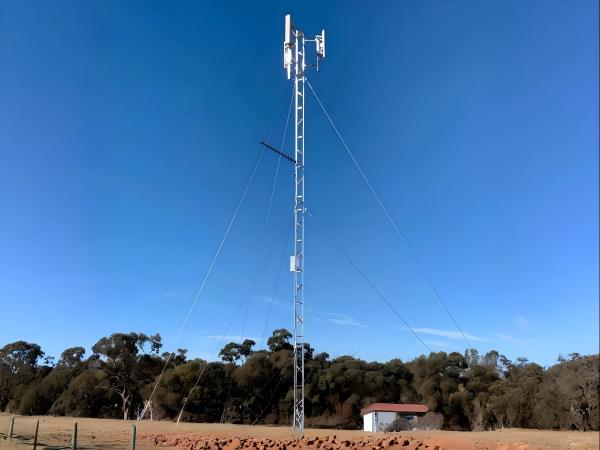
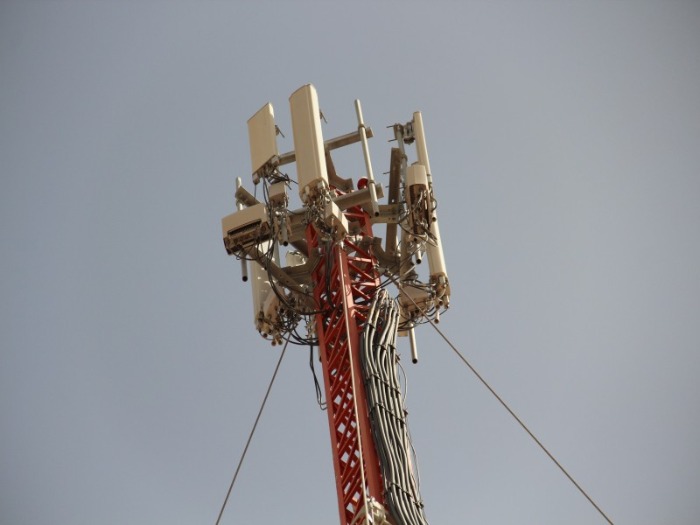
In the relentless pursuit of expansive wireless coverage—for broadcasting, long-haul microwave links, or next-generation mobile networks—height is the ultimate asset.
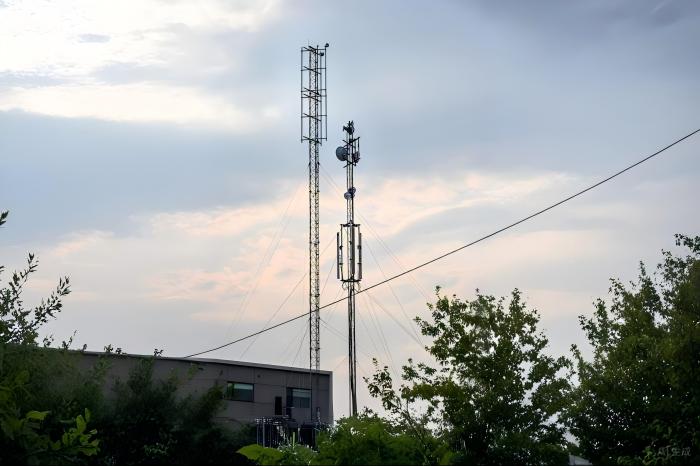
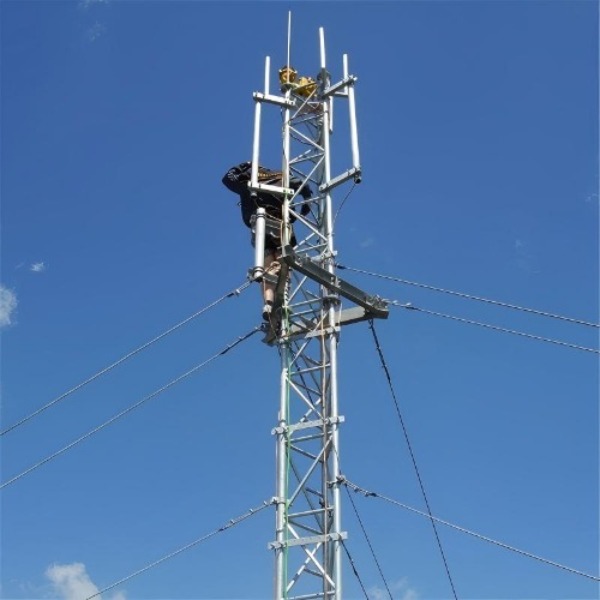
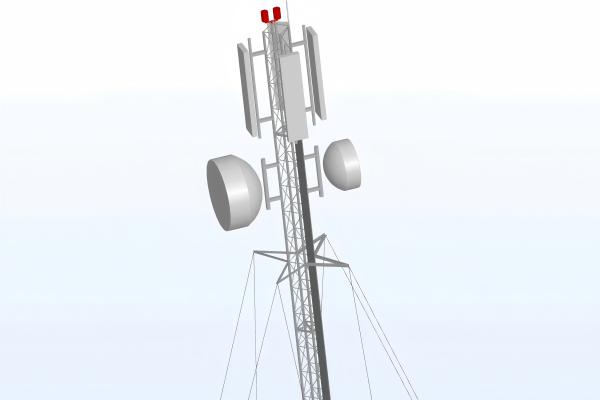
guyed mast tower


It extends line-of-sight, clears terrain obstacles, and maximizes the economic value of a single site. However, for traditional self-supporting towers (monopoles or lattice), increasing height incurs a crippling economic penalty: material costs and foundation demands escalate exponentially. Beyond approximately 150-180 meters, the conventional paradigm breaks. This is where the guyed mast tower asserts its engineering and economic supremacy. By masterfully leveraging tensioned cables, it defies gravity not through brute mass, but through intelligent force distribution, fundamentally altering the relationship between height and cost for structures reaching 200, 300, and even 400 meters.

This blog deconstructs the core principles that allow guyed towers to achieve extreme heights with remarkable material economy.


The Cost-Height Conundrum: Why Self-Supporting Towers Hit a Wall

For a self-supporting tower, every additional meter of height must resist increasing overturning moments from wind. This resistance is provided solely by the tower's own bending stiffness and the foundation's ability to resist uplift. The result is a cubic relationship between height and material requirement. Doubling the height of a freestanding tower typically requires approximately eight times the material in the lower sections to maintain stability. Foundations become massive, deep-piled structures to prevent tipping. This makes self-supporting designs beyond 180-200m prohibitively expensive and logistically daunting.
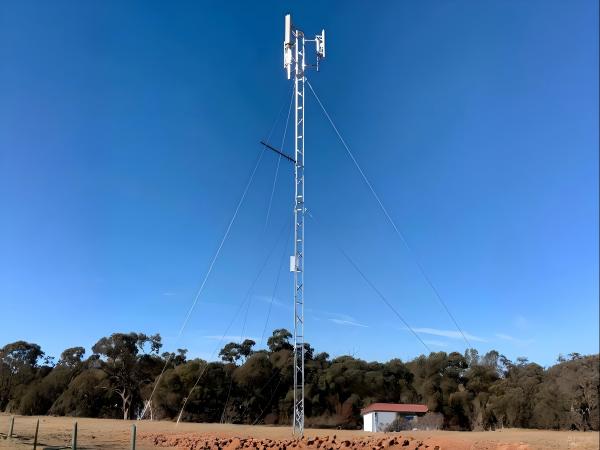
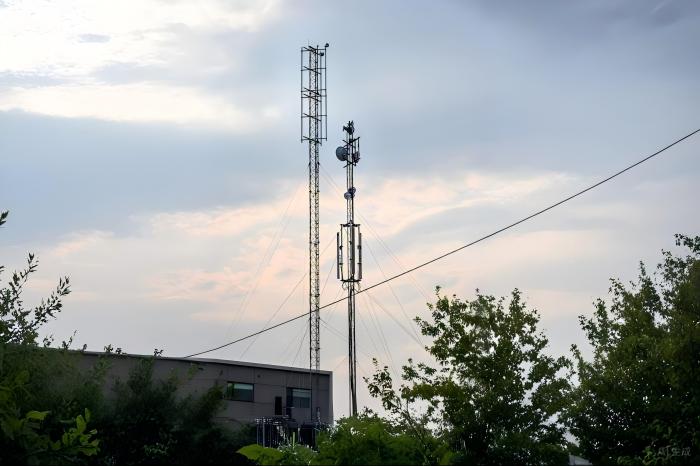
guyed wire tower


The Guyed Mast Paradigm: Replacing Bending with Tension

The guyed mast inverts this problem. It is a slender, vertical column (the mast), stabilized not by its own girth, but by a system of high-strength steel guy cables anchored to the ground at radial distances. This system transforms the primary structural action from bending (inefficient) to axial compression and tension (highly efficient).


  1. · Load Transformation: When wind pushes against the mast, it attempts to bend it. The guy cables on the leeward side resist this motion by going into tension. This tension pulls the mast back toward vertical, while the windward cables slacken slightly. The mast itself primarily experiences axial compression, a load case where steel performs with exceptional efficiency.

  2. · The Power of Pre-Tension: The cables are not installed slack. They are pre-tensioned during erection to a calculated load. This initial tension ensures all cables remain taut under varying wind directions, eliminating destructive dynamic slack-tighten cycles that cause fatigue. Pre-tension also increases the system's natural frequency, improving its dynamic stability.


Core Engineering Principles Enabling Economic Height

1. Material Efficiency and Optimal Force Resolution
The mast can be an incredibly slender steel tube or lattice section because it does not need massive bending strength. Its primary job is to carry its weight and the equipment load as a column. The immense lateral wind force is resolved into manageable axial forces: compression in the mast and tension in the cables. High-strength steel cable, with a tensile strength far exceeding that of structural steel used in compression, handles this tension with minimal material. This separation of functions—compression vs. tension—allows each material to be used where it performs best, leading to a structure that is often less than half the weight of an equivalent-height self-supporting tower.
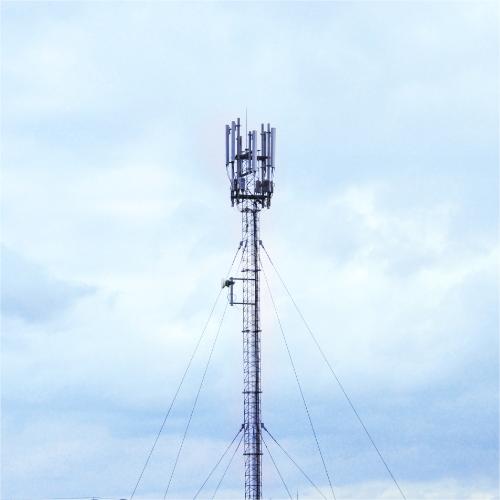
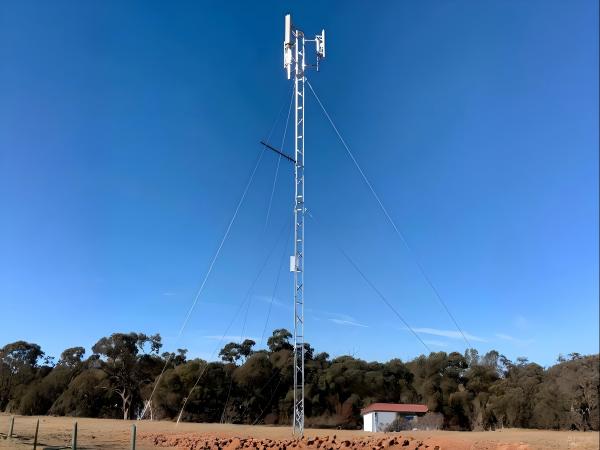
guyed wire tower

2. The Geometry of Stability: Anchor Radius and Guy Levels
The system's stiffness and economy are dictated by geometry.

  1. Anchor Radius: The distance from the mast base to the ground anchors. A larger radius allows the guy cables to act at a more favorable angle, reducing the tension required in the cables to counteract a given wind moment. This is a key economic lever.

  2. Multiple Guy Levels: Tall masts employ several sets of guy cables attached at different heights. This breaks the mast into a series of shorter, effectively braced columns, preventing global buckling and minimizing mast diameter. The optimal number and spacing of guy levels are calculated to minimize total material (mast + cable) cost.

3. Foundation Simplification: From Uplift to Gravity
This is a transformative cost advantage. A self-supporting tower foundation must be designed as a moment-resisting system, fighting enormous uplift and overturning forces with deep piles or massive concrete counterweights. A guyed mast foundation is simplified:

  1. Mast Foundation: Primarily carries a straightforward vertical compressive load (the weight of the structure). It is a simple slab or pile cap.

  2. Anchor Foundations: These are designed to resist pure vertical uplift from the cable tension. While significant, designing for pure uplift using dead weight (concrete blocks) or rock anchors is fundamentally simpler, requires less complex reinforcement, and is far more cost-effective per kilonewton of resistance than a moment-resisting foundation.

4. Aerodynamic and Dynamic Mastery
At extreme heights, dynamic response is critical.


  1. Aerodynamic Damping: The system has inherent damping. Energy from wind gusts is dissipated through slight, elastic stretching and vibration of the long cable runs.

  2. Avoiding Resonance: The fundamental natural frequency of a well-designed guyed mast is typically very low (e.g., 0.2-0.5 Hz), safely below the frequency of vortex shedding from the slender mast and the forcing frequencies of wind turbulence. Supplemental dampers (e.g., Stockbridge dampers on cables) can be added to suppress specific wind-induced vibrations.
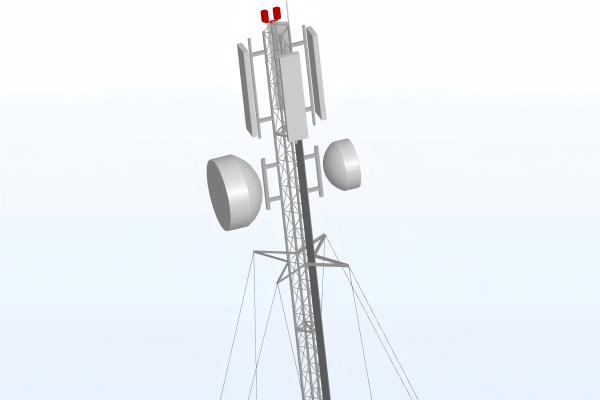

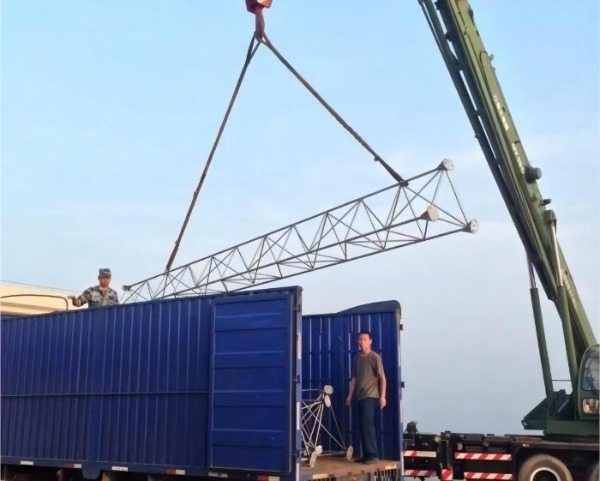
guyed wire tower


Breaking the Linear Cost-Height Relationship

The combined effect of these principles is a dramatic flattening of the cost curve. Where a self-supporting tower's cost escalates exponentially, the guyed mast's cost increases at a rate much closer to linear with height. The additional material for a taller guyed mast is primarily incremental: more length of the slender mast section and longer guy cables. The fundamental engineering components—the concept of load transfer via tension, the foundation types—do not change, allowing for scalable design.

Comparative Snapshot: 250m Tower


  1. · Self-Supporting Lattice Tower: Would require a massive, tapered lattice base with enormous member sizes, a extraordinarily complex and deep foundation system, and total steel weight potentially exceeding 1,500 tons.

  2. · Guyed Mast: Would employ a relatively uniform, slender tubular mast (perhaps 2-3m diameter), 3-4 levels of guy cables, and a set of gravity block or anchor foundations. Total steel weight might be under 500 tons. The cost difference can be a factor of 2-3x in favor of the guyed solution.
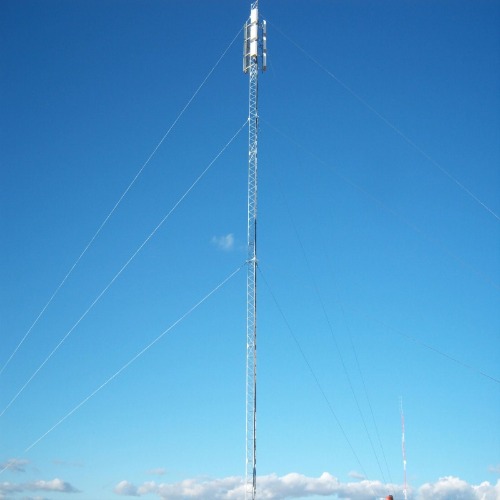

guyed wire antenna tower


Conclusion: The Intelligent Path to the Stratosphere

Guyed communication towers represent a triumph of principle-based engineering over brute force. By understanding and harnessing the efficient load-carrying mechanisms of tension and compression, and by using the ground itself as a key structural component via anchors, they solve the problem of extreme height in the most materially economical way possible.

They are not suitable for every site—requiring significant land for anchor radii—but where space allows, they are the undisputed, most economical solution for piercing the 200-meter barrier and beyond. In defying gravity to connect the world, they prove that the most powerful engineering isn't about using more, but about using force more intelligently. For reaching the skies in pursuit of coverage, the guyed mast remains the most rational, gravity-defying choice.


 Learn more at   www.alttower.com
 

Contact Us

The wind energy industry is engaged in a quiet but relentless race upward. A decade ago, a 70-meter wind turbine was considered substantial. Today, 100-meter hub heights are standard, and turbines reaching 150 meters and beyond are increasingly common. For developers planning multi-million dollar wind farms, the stakes are enormous: a 10% error in wind speed assessment can translate to 30% variance in energy production estimates—and millions in revenue uncertainty. The foundation of accurate wind resource assessment is the meteorological (met) tower, which must rise to at least the hub height of the proposed turbines. As turbines climb, so must the towers that measure the wind. In this pursuit of height, the guyed lattice tower has emerged as the undisputed industry standard.


wind measurement met tower


The Height Imperative: Matching Turbine Hub Heights

Wind speed increases with elevation—a phenomenon known as wind shear. But this relationship is not linear or universal. It varies by terrain, atmospheric stability, and local geography. To accurately predict energy production, developers must measure wind speed at the actual height where turbines will operate.

Modern utility-scale turbines routinely feature hub heights of 100 to 160 meters. Offshore turbines and next-generation onshore models push toward 200 meters. A met tower that measures only at 60 or 80 meters forces developers to extrapolate wind speeds upward using theoretical models—models that can introduce unacceptable uncertainty into multi-million dollar investment decisions.

The industry standard, therefore, has become 100-meter met towers for onshore wind development, with taller structures specified for projects with higher hub heights or complex terrain.


The Structural Challenge: How to Reach 100+ Meters

Reaching 100 meters with a self-supporting structure is possible but economically punishing. A self-supporting lattice tower at this height requires substantial steel in its base sections—the cubic relationship between height and material demand drives costs exponentially upward. Foundations become massive concrete blocks or deep pile systems designed to resist enormous overturning moments.

The guyed tower solves this problem through a fundamental shift in structural behavior. Instead of resisting wind forces through the tower's own bending strength, it transfers lateral loads into tension in the guy cables and compression in the slender mast. This separation of function allows the mast to be remarkably lightweight—a uniform cross-section rather than a dramatically tapered base.

Comparative Material Efficiency

For a 100-meter tower:

  1. Self-supporting lattice: Requires substantial steel in base sections, often 50-80 tons total.

  2. Guyed lattice: A slender mast with 3-4 levels of guy cables, total steel weight often 15-25 tons—a 50-70% reduction.


This material efficiency translates directly to fabrication, transportation, and installation savings.


wind measurement met tower


Technical Advantages of Guyed Towers for Wind Measurement

Beyond raw material economy, guyed towers offer specific advantages for met tower applications.

1. Minimal Flow Distortion
Wind measurement requires the sensing equipment to be placed in undisturbed airflow. A self-supporting tower, with its substantial cross-section and massive base, can create wake effects that distort readings from anemometers mounted on the structure. The slender profile of a guyed mast minimizes this flow interference, providing cleaner, more accurate data.

2. Adaptable Siting in Complex Terrain
Wind farms are often located in precisely the areas where self-supporting towers are hardest to erect: ridgelines, steep slopes, remote forested areas. Guyed towers, with their modular components and ability to be erected with smaller cranes or even helicopter assistance, adapt readily to challenging sites.

3. Lower Foundation Impact
The central foundation of a guyed tower carries primarily compression from the mast's weight. Three or four anchor foundations, spaced radially, resist cable tension. This distributed system requires less concrete volume and can often be installed with minimal earth disturbance—a significant advantage in environmentally sensitive areas or on rocky terrain where excavating a single massive foundation is impractical.

4. Reduced Visual Impact
For temporary measurement campaigns (typically 1-3 years), the visual footprint matters. A slender guyed tower is far less intrusive than a massive self-supporting structure, easing permitting in areas with aesthetic concerns.


guyed mast tower


Cost Economics: Breaking the Height-Cost Curve

The economic advantage of guyed towers at 100+ meters is decisive:


Height Self-Supporting Cost Guyed Tower Cost Ratio
60m Baseline Baseline 1:1
80m 2.0x 1.4x 1.4:1
100m 3.5x 1.8x 1.9:1
120m 5.5x 2.2x 2.5:1

(These ratios are illustrative; actual figures vary by location and design specifications.)

The cost differential widens with height because the self-supporting tower's material and foundation requirements escalate exponentially, while the guyed tower's cost increases at a rate much closer to linear.


Application: The Measurement Campaign Lifecycle

A typical wind measurement campaign follows a predictable pattern that aligns perfectly with guyed tower capabilities:

  1. · Site Selection: The tower must be positioned in the zone of intended turbine development, often on ridgelines or open terrain where self-supporting tower foundations would be most challenging.

  2. · Permitting: Guyed towers, with their lower visual impact and reduced foundation footprint, often secure approvals more quickly, especially in areas with scenic or agricultural protections.

  3. · Installation: The modular design allows for erection with smaller cranes. A 100-meter guyed tower can be installed in 3-5 days with a crew of 4-6, compared to 2-3 weeks for a self-supporting structure.

  4. · Measurement Period: Typically 12-24 months of continuous data collection, with anemometers mounted at multiple heights (often 40m, 60m, 80m, 100m, and sometimes 120m). Guyed towers accommodate instrument booms with minimal flow distortion.

  5. · Decommissioning: Once the wind farm is financed and construction begins, the met tower is removed. Guyed towers disassemble efficiently, leaving behind only the small anchor foundations, which can be removed or left with minimal land impact.


guyed mast tower


Conclusion: The Rational Choice for Wind Resource Assessment

As wind turbines continue their ascent toward 100, 120, and 150-meter hub heights, the measurement infrastructure must follow. The guyed lattice tower offers the optimal combination of height capability, cost efficiency, and measurement accuracy for modern wind resource assessment campaigns. Its material efficiency, logistical adaptability, and minimal flow distortion make it the industry standard for developers seeking to minimize uncertainty in their multi-million dollar investments.

For a project where a 10% error in wind speed means a 30% error in revenue, the ability to measure accurately at the correct height is not a luxury—it is a necessity. And for reaching those heights, the guyed tower remains the most rational, economical, and technically sound choice.

Keywords: Guyed Tower, Met Tower, Wind Measurement, Wind Resource Assessment, Hub Height, Lattice Tower, Wind Energy, Renewable Energy Infrastructure.


In the hierarchy of telecommunication infrastructure, height is the ultimate differentiator. For broadcasters seeking to blanket entire regions with FM or TV signals, for long-haul microwave links requiring unobstructed line-of-sight, and for rural network operators aiming to cover vast territories with minimal sites, the ability to reach extreme altitudes is not a luxury—it is a fundamental requirement. When the target height exceeds 150 meters, the field of viable structural options narrows dramatically. And when it approaches 300 meters or more, one tower type stands alone as the undisputed champion: the guyed mast.

guyed mast tower


This blog presents a comparative analysis of tower types at ultra-tall heights, examining why guyed towers dominate the skyline where others cannot economically or technically follow.


The Height Threshold: Where Other Towers Stop

Every tower type has an inherent height ceiling, dictated by the laws of structural mechanics and economic reality.


Tower Type Typical Maximum Height Primary Limiting Factor
Monopole 60 meters (200 feet) Exponential increase in steel thickness and foundation size beyond this point 
Self-Supporting Lattice 200 meters Cubic relationship between height and material required for base sections 
Guyed Mast 600+ meters Land availability for anchor radius; structural capacity continues with linear cost scaling 

A monopole's single, tapered tube must resist all bending moments through its own flexural stiffness. Doubling its height typically requires eight times the material in the lower sections and a foundation of immense proportions. This is why monopoles are rarely specified above 60 meters .

Self-supporting lattice towers perform better, with their wide bases and triangulated frames distributing loads efficiently. However, they too face a harsh economic reality: the relationship between height and material consumption is nonlinear. A 200-meter lattice tower requires significantly more than twice the steel of a 100-meter version . Above this range, the structure becomes prohibitively massive.

Guyed towers break this paradigm entirely.


The Engineering Secret: Tension as the Primary Load Path

The guyed mast achieves its height dominance through a fundamental shift in structural behavior. Rather than resisting wind forces through bending—an inefficient use of steel—it transforms those forces into tension in the guy cables and compression in the slender mast .

  1. The mast carries primarily vertical loads: its own weight, the equipment, and the downward component of cable tension. It needs sufficient stiffness to resist buckling between guy levels, but it does not require the massive bending strength of a self-supporter.

  2. The guy cables, typically three or four sets arranged radially, resist the lateral wind forces. High-strength steel cable, with tensile strengths far exceeding structural steel, handles these forces with minimal material cross-section .

  3. The anchors transfer cable tension into the ground through gravity blocks or rock anchors, designed for pure uplift resistance rather than complex moment-resisting foundations .


This separation of function—compression in the mast, tension in the cables—allows each component to be optimized for its specific role. The result is a structure that can reach 600 meters or more with a total steel weight far less than a self-supporter of equivalent height .

guyed mast antenna tower


Economic Analysis: Breaking the Cost-Height Curve

The economic advantage of guyed towers at extreme heights is decisive. The cost of a self-supporting tower escalates exponentially with height; the guyed mast's cost escalates at a rate much closer to linear.


Material Costs

A guyed tower uses significantly less steel. The mast remains relatively uniform in cross-section throughout its height, and the cables add minimal material mass. For a 300-meter structure, the material savings compared to a self-supporting lattice tower can exceed 50% .


Foundation Costs

This is where the difference becomes stark. A self-supporting tower requires a single, massive foundation designed to resist enormous overturning moments. This often means deep piles, immense concrete volumes, and complex reinforcement. A guyed tower's central foundation carries only compression—a simple slab or pile cap. The anchor foundations, while multiple, are designed for pure uplift and are generally less expensive per unit of resistance . However, this advantage is location-dependent: rocky terrain can make excavating multiple anchor points costly .


Installation and Logistics

The lighter, modular components of a guyed mast are easier to transport to remote sites—a common requirement for rural broadcast applications . Erection is systematic: the mast is assembled in sections and raised while cables are progressively tensioned. While specialized, this process is well-established and predictable.


guyed wire tower


The Space Trade-Off: Why Guyed Towers Need Room

The primary drawback of the guyed tower is its land footprint. The guy anchors extend radially from the base, typically at a distance of 60-80% of the tower height . For a 300-meter tower, this means an anchor radius of 180-240 meters, requiring a substantial land area free of obstructions and buildings.

This is why guyed towers are the antithesis of urban infrastructure. In dense cities, where land is precious and zoning is strict, monopoles or self-supporting lattice towers are the only options . But in rural areas, on mountaintops, and in open plains—precisely where ultra-tall towers are most needed—land is available, and the guyed tower's space requirement becomes an acceptable trade-off for its height capability .


Application Scenarios: Where Guyed Towers Excel

The guyed mast is not a general-purpose solution; it is a specialized tool for specific, demanding applications :

1. Broadcasting (FM, TV, HDTV)
Broadcast signals require elevation to achieve line-of-sight coverage over large populations. A 300-600 meter guyed mast atop a hill or in a plain can serve an entire metropolitan region. The Senior Road Tower in Missouri City, Texas, standing at 601 meters, serves as the primary transmitting facility for nine FM radio stations . No other tower type could economically achieve this height with the necessary antenna capacity.

2. Long-Haul Microwave Relay
Microwave links require unobstructed paths between repeaters. In flat or gently rolling terrain, elevation is the only way to achieve this. Guyed towers provide the height needed to clear tree lines, buildings, and terrain features, enabling reliable backhaul over tens of kilometers .

3. Rural and Remote Coverage
For cellular coverage in sparsely populated areas, a single tall tower can replace multiple shorter structures . The guyed mast's cost-effectiveness at height makes it the preferred choice for network operators seeking to minimize site count and backhaul complexity.


4. Lightning Protection and Instrumentation
In industrial settings, guyed towers serve dual purposes as lightning masts for refineries, chemical plants, and other facilities requiring protection over large areas .


guyed wire tower


Comparative Summary: Guyed vs. Lattice vs. Monopole at 200m+


Parameter Guyed Mast Self-Supporting Lattice Monopole
Maximum Practical Height 600+ m  ~200 m  ~60 m 
Relative Steel Weight Low (baseline) 2-3x heavier Not feasible at this height
Foundation Complexity Moderate (multiple anchors) High (single massive base) N/A
Land Required Large (anchor radius) Moderate (base only) N/A
Installation Cost Moderate High N/A
Maintenance High (cable tension, anchors)  Moderate (joint inspection) N/A
Typical Applications Broadcast, long-haul microwave, rural coverage  Broadcast, cellular at moderate height Urban, suburban

Conclusion: The Rational Choice for Extreme Heights

When the requirement is to reach beyond 200 meters—into the realm where signals travel hundreds of kilometers and coverage spans entire regions—the engineering and economic debate converges on a single conclusion. The guyed mast is not merely an alternative; it is the only rational choice.

Its ability to transform wind forces into efficient tension loads, its linear cost scaling with height, and its proven track record in the world's tallest structures all point to its dominance. The Senior Road Tower  and countless others like it stand as testaments to a design philosophy that leverages the ground itself as a structural component.

For network planners facing the challenge of ultra-tall requirements, the decision framework is clear: if you have the land and need the height, the guyed tower delivers capability that no other structure can match at any price. It is, and will remain, the height champion of telecommunications infrastructure.


 Learn more at   www.alttower.com
 

Contact Us

keyboard_arrow_up