In the hierarchy of telecommunication infrastructure, height is the ultimate differentiator. For broadcasters seeking to blanket entire regions with FM or TV signals, for long-haul microwave links requiring unobstructed line-of-sight, and for rural network operators aiming to cover vast territories with minimal sites, the ability to reach extreme altitudes is not a luxury—it is a fundamental requirement. When the target height exceeds 150 meters, the field of viable structural options narrows dramatically. And when it approaches 300 meters or more, one tower type stands alone as the undisputed champion: the guyed mast.
This blog presents a comparative analysis of tower types at ultra-tall heights, examining why guyed towers dominate the skyline where others cannot economically or technically follow.
The Height Threshold: Where Other Towers Stop
Every tower type has an inherent height ceiling, dictated by the laws of structural mechanics and economic reality.
| Tower Type | Typical Maximum Height | Primary Limiting Factor |
|---|---|---|
| Monopole | 60 meters (200 feet) | Exponential increase in steel thickness and foundation size beyond this point |
| Self-Supporting Lattice | 200 meters | Cubic relationship between height and material required for base sections |
| Guyed Mast | 600+ meters | Land availability for anchor radius; structural capacity continues with linear cost scaling |
A monopole's single, tapered tube must resist all bending moments through its own flexural stiffness. Doubling its height typically requires eight times the material in the lower sections and a foundation of immense proportions. This is why monopoles are rarely specified above 60 meters .
Self-supporting lattice towers perform better, with their wide bases and triangulated frames distributing loads efficiently. However, they too face a harsh economic reality: the relationship between height and material consumption is nonlinear. A 200-meter lattice tower requires significantly more than twice the steel of a 100-meter version . Above this range, the structure becomes prohibitively massive.
Guyed towers break this paradigm entirely.
The Engineering Secret: Tension as the Primary Load Path
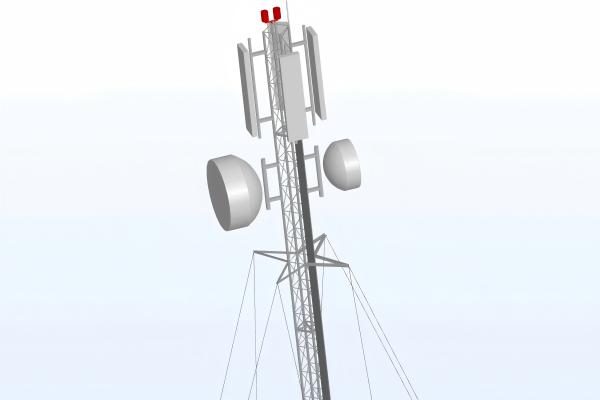
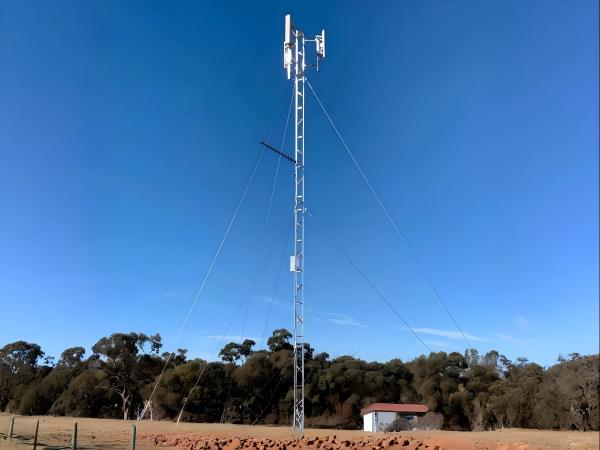
The guyed mast achieves its height dominance through a fundamental shift in structural behavior. Rather than resisting wind forces through bending—an inefficient use of steel—it transforms those forces into tension in the guy cables and compression in the slender mast .
-
The mast carries primarily vertical loads: its own weight, the equipment, and the downward component of cable tension. It needs sufficient stiffness to resist buckling between guy levels, but it does not require the massive bending strength of a self-supporter.
-
The guy cables, typically three or four sets arranged radially, resist the lateral wind forces. High-strength steel cable, with tensile strengths far exceeding structural steel, handles these forces with minimal material cross-section .
-
The anchors transfer cable tension into the ground through gravity blocks or rock anchors, designed for pure uplift resistance rather than complex moment-resisting foundations .
This separation of function—compression in the mast, tension in the cables—allows each component to be optimized for its specific role. The result is a structure that can reach 600 meters or more with a total steel weight far less than a self-supporter of equivalent height .
Economic Analysis: Breaking the Cost-Height Curve
The economic advantage of guyed towers at extreme heights is decisive. The cost of a self-supporting tower escalates exponentially with height; the guyed mast's cost escalates at a rate much closer to linear.
Material Costs
A guyed tower uses significantly less steel. The mast remains relatively uniform in cross-section throughout its height, and the cables add minimal material mass. For a 300-meter structure, the material savings compared to a self-supporting lattice tower can exceed 50% .
Foundation Costs
This is where the difference becomes stark. A self-supporting tower requires a single, massive foundation designed to resist enormous overturning moments. This often means deep piles, immense concrete volumes, and complex reinforcement. A guyed tower's central foundation carries only compression—a simple slab or pile cap. The anchor foundations, while multiple, are designed for pure uplift and are generally less expensive per unit of resistance . However, this advantage is location-dependent: rocky terrain can make excavating multiple anchor points costly .
Installation and Logistics
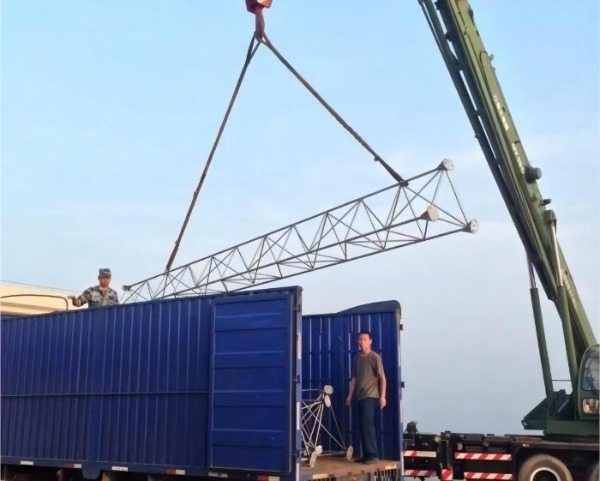
The lighter, modular components of a guyed mast are easier to transport to remote sites—a common requirement for rural broadcast applications . Erection is systematic: the mast is assembled in sections and raised while cables are progressively tensioned. While specialized, this process is well-established and predictable.
The Space Trade-Off: Why Guyed Towers Need Room
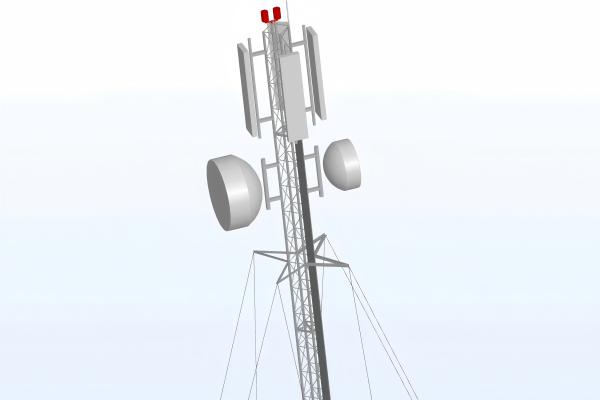
The primary drawback of the guyed tower is its land footprint. The guy anchors extend radially from the base, typically at a distance of 60-80% of the tower height . For a 300-meter tower, this means an anchor radius of 180-240 meters, requiring a substantial land area free of obstructions and buildings.
This is why guyed towers are the antithesis of urban infrastructure. In dense cities, where land is precious and zoning is strict, monopoles or self-supporting lattice towers are the only options . But in rural areas, on mountaintops, and in open plains—precisely where ultra-tall towers are most needed—land is available, and the guyed tower's space requirement becomes an acceptable trade-off for its height capability .
Application Scenarios: Where Guyed Towers Excel
The guyed mast is not a general-purpose solution; it is a specialized tool for specific, demanding applications :
1. Broadcasting (FM, TV, HDTV)
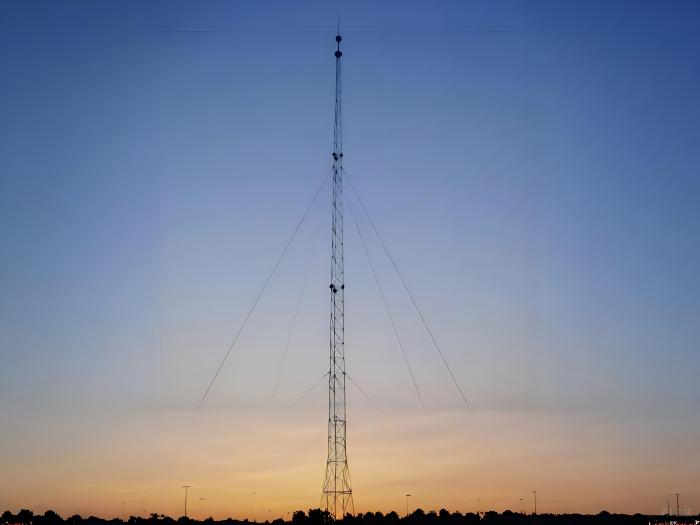
Broadcast signals require elevation to achieve line-of-sight coverage over large populations. A 300-600 meter guyed mast atop a hill or in a plain can serve an entire metropolitan region. The Senior Road Tower in Missouri City, Texas, standing at 601 meters, serves as the primary transmitting facility for nine FM radio stations . No other tower type could economically achieve this height with the necessary antenna capacity.
2. Long-Haul Microwave Relay
Microwave links require unobstructed paths between repeaters. In flat or gently rolling terrain, elevation is the only way to achieve this. Guyed towers provide the height needed to clear tree lines, buildings, and terrain features, enabling reliable backhaul over tens of kilometers .
3. Rural and Remote Coverage
For cellular coverage in sparsely populated areas, a single tall tower can replace multiple shorter structures . The guyed mast's cost-effectiveness at height makes it the preferred choice for network operators seeking to minimize site count and backhaul complexity.
4. Lightning Protection and Instrumentation
In industrial settings, guyed towers serve dual purposes as lightning masts for refineries, chemical plants, and other facilities requiring protection over large areas .
Comparative Summary: Guyed vs. Lattice vs. Monopole at 200m+
| Parameter | Guyed Mast | Self-Supporting Lattice | Monopole |
|---|---|---|---|
| Maximum Practical Height | 600+ m | ~200 m | ~60 m |
| Relative Steel Weight | Low (baseline) | 2-3x heavier | Not feasible at this height |
| Foundation Complexity | Moderate (multiple anchors) | High (single massive base) | N/A |
| Land Required | Large (anchor radius) | Moderate (base only) | N/A |
| Installation Cost | Moderate | High | N/A |
| Maintenance | High (cable tension, anchors) | Moderate (joint inspection) | N/A |
| Typical Applications | Broadcast, long-haul microwave, rural coverage | Broadcast, cellular at moderate height | Urban, suburban |